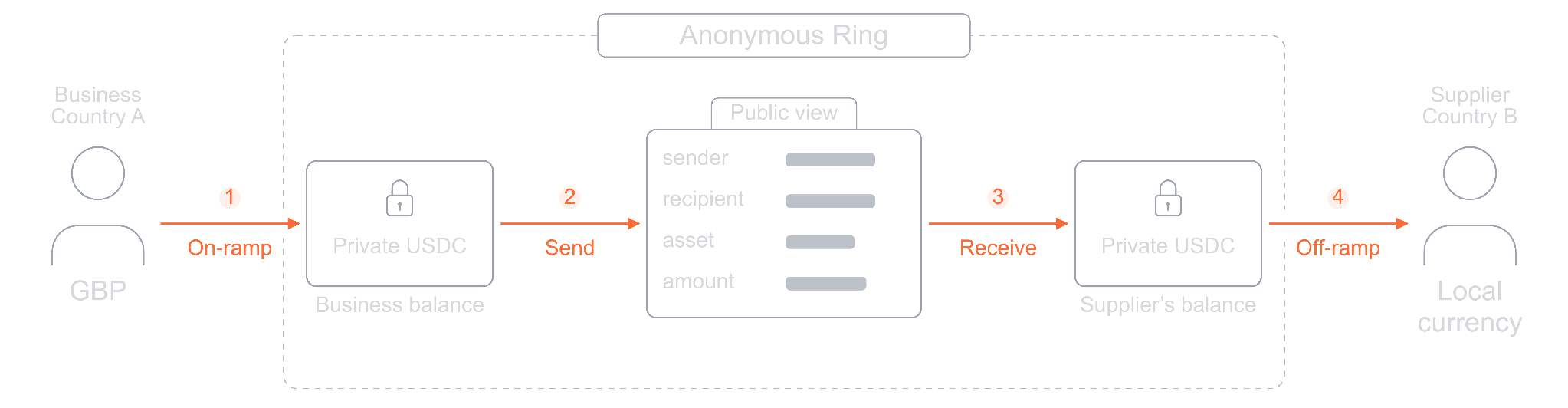
This guide is for fintechs, issuers, payroll platforms, remittance companies, neobanks, and enterprises that want private payment accounts combined with the benefits of blockchain.

Overview

Your business will be able to:
  1. Create private wallets for customer, merchant, or treasury accounts
  2. Deposit stablecoins from public to private wallets
  3. Send private payments between private wallets
  4. Withdraw to public Solana addresses and wallets
  5. View private balances and history through API
  6. Define dedicated Custom Rings with your own compliance, auditing, and business rules. You can either bring your own compliance, or use Helius’ managed KYC and sanction screening solution.
  7. Configure who can view, approve, freeze, or move funds inside a ring
  8. Track private payment status through polling or webhooks

How It Works

A Private Wallet is the core API object you interact with. You can map a Private Wallet to, for example, a customer account, merchant account, employee account, treasury account, or smart account. Balances and private transfers are encrypted onchain. RPC providers such as Helius index encrypted state, generate proofs, build transactions, and submit them to Solana on demand. For most enterprise use cases, Private Wallets live inside a dedicated Custom Ring. The ring defines the rules for transfers, visibility, and compliance. Here is how Helius Privacy fits into your stack: Trust model. The Enterprise App submits intent to the Privacy API / RPC Provider, which calls the Wallet Provider for key operations and submits transactions to Solana.

Trust Model

Private payments require authorization by the private wallet and must comply with the respective ring policy. Confidential rings (the Default Ring and confidential Custom Rings) support local and delegated decryption. Anonymous Custom Rings support only delegated decryption. In delegated decryption mode, the wallet and selected RPC provider share a viewing key. The provider can serve balances and history but cannot authorize spending. This is distinct from an auditor, whose visibility is defined by Ring policy. You can run the infrastructure (RPC, indexer, auditor server, or co-signer) yourself, or use an RPC provider such as Helius to run it for you. We run the infrastructure through our global fleet of high-performance RPCs, and optionally via a dedicated setup customizable to your requirements. Dedicated infrastructure does not imply a separate onchain state tree. Custom Rings and the permissionless Default Ring share one Merkle tree.

Rings

Rings make privacy on Solana programmable, similar to Token-2022. The Default Ring is permissionless and has no custom policy. A Custom Ring is governed by its own policy ruleset. One Private Wallet can hold balances in multiple Rings at the same time. Which Ring a balance belongs to is not a property of the wallet. It is a property of each UTXO, stored in its policy_program_id field.
  • The default ring is confidential and permissionless without any policy, auditors, or authorities. Confidential rings encrypt asset and amount.
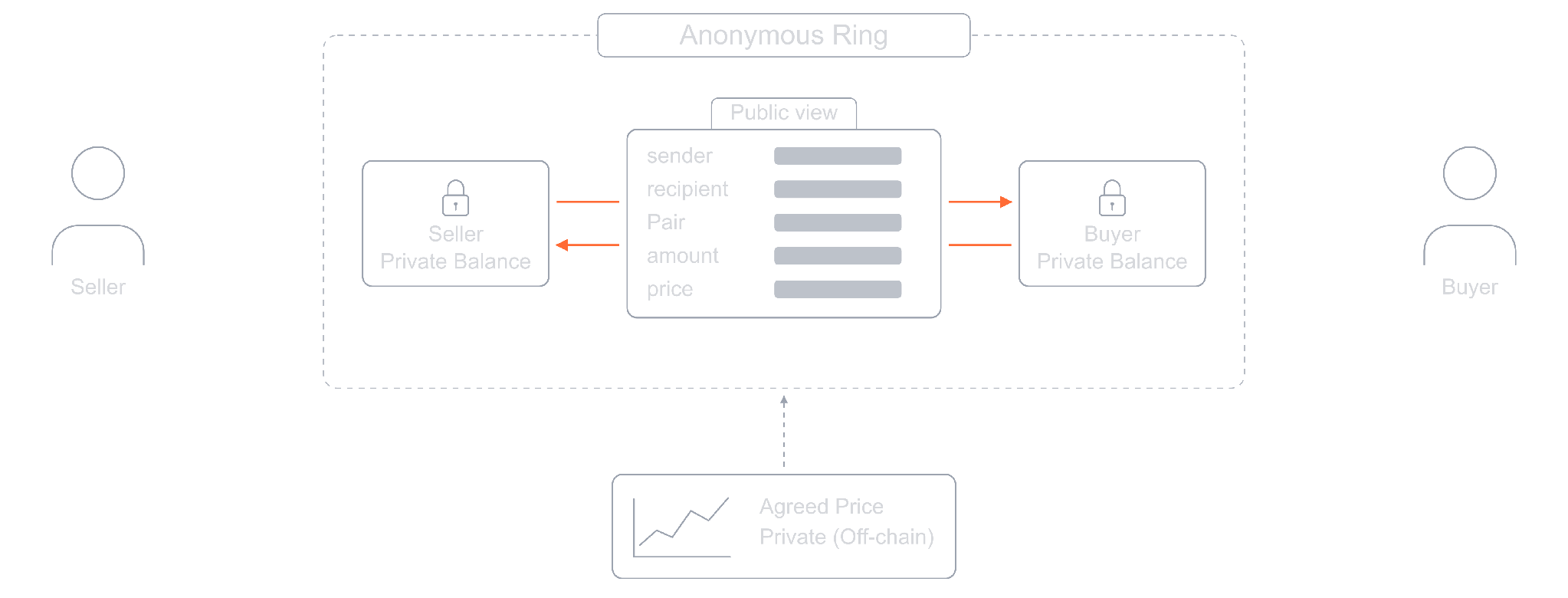
  • Custom rings can be configured with custom policy and compliance controls and be confidential or anonymous (encrypted asset, amount, sender, recipient).
Private Balances shown as a dashed onchain zone holding two rings. The Default Ring is confidential, self-custodial, and permissionless. The Custom Ring is confidential or anonymous, self-custodial, and adds custom policy and custom compliance. A private transfer connects the rings, and each deposits into and withdraws from a Solana Public Balances layer below. A private wallet can withdraw from a Custom Ring to a public token account, to the confidential and permissionless Default Ring, or to another Custom Ring if the source ring policy permits it.

Custom Rings Are Programmable

A Custom Ring can define fully custom rules for transfers and visibility/auditing.
If you want to set up your own Custom Ring, contact us and we will get you set up. You can either bring your own compliance, or use Helius’ managed KYC and sanction screening solution.
Rings are programmable. Common examples of rules include: Such custom rulesets are programmed as a dedicated Solana program that verifies each applicable transfer’s state transition before it atomically settles onchain through the Solana Privacy Protocol (TSPP).

Ring Administration

Ring Reporting

Use ring reporting for treasury, accounting, compliance, or your own visibility ruleset.
Example response:
Auditor access is read-only. An auditor can view the data configured by the ring policy, but cannot sign, spend, freeze, or move funds unless separately configured as an authority.

Freeze or Thaw a Private Wallet

If the Custom Ring has a freeze authority, you can freeze or thaw a Private Wallet according to policy.
Example response:
Thaw:

Monitoring via Webhooks

Use webhooks for transfer lifecycle updates.
Example event:

Security and Privacy Properties

  • Helius API keys authenticate enterprise projects. They do not authorize spending. Spending authorization requires a wallet signature, alternative authorization through the underlying key management service (such as Privy or Turnkey), or, if configured, ring policy.
  • Private key material is held in Wallet Provider-managed secure infrastructure.
  • Helius does not receive or export private spending keys.
  • In delegated decryption mode, the wallet and provider share a viewing key. The provider can read balances and history but cannot authorize spending.
  • Custom Ring auditors can view configured ring activity but cannot spend.
  • Transactions to or within a Custom Ring publicly invoke its policy program.
  • Co-signers approve selected transfers but cannot spend alone unless policy allows it.
  • Freeze authorities can freeze or thaw balances only if the ring policy allows it.
  • Permanent delegates can move balances only if explicitly configured in the ring policy.
  • Private transfers inside a ring do not reveal asset or amount onchain. A confidential ring reveals sender and recipient; an anonymous ring uses a relayer and does not reveal either party. Ring policy may specify additional visibility.
  • Withdrawals reveal destination, asset, and amount.
  • Public crypto deposits reveal source, asset, and amount. On-ramp from a fiat balance keeps asset and amount private (encrypted onchain).
  • Public transfers reveal sender, recipient, asset, and amount.

Didn’t find what you were looking for?

Reach out! Telegram | E-Mail | Contact